
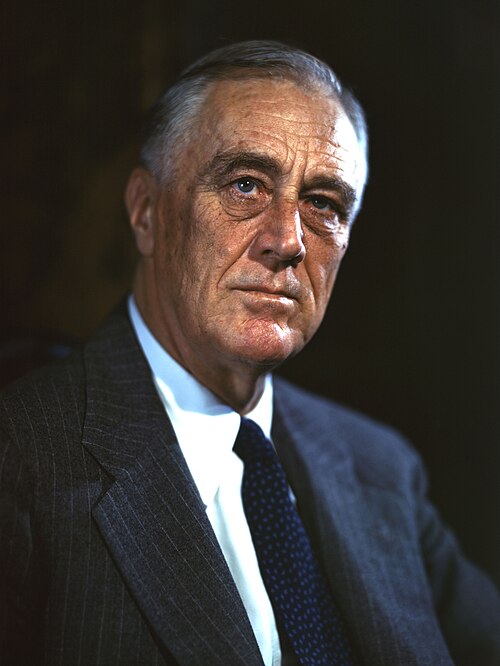
Franklin Delano Roosevelt led the United States through two of the most brutal chapters in modern history. The Great Depression. World War II. And somehow, in the middle of all of it, he was also fighting a quieter battle every single day at the dinner table. Behind the fireside chats and the New Deal, there was a fascinating food story hiding in plain sight: a wealthy aristocrat forced to eat prune pudding for the press, a man who privately craved grilled cheese and jelly donuts, and one of the worst amateur bartenders in presidential history. This is the full story of what FDR ate, drank, and endured inside the White House kitchen.
The Famous 7-Cent Lunch
Two weeks into his presidency, with breadlines stretching around city blocks across the country, Roosevelt sat down to a very deliberate lunch: hot deviled eggs in tomato sauce, mashed potatoes, and prune pudding. The total cost came to roughly 7.5 cents per person. Eleanor had designed the meal alongside the Bureau of Home Economics, with eggs chosen for iron and protein, potatoes for energy, and prunes and tomatoes for vitamins. The message was impossible to miss. Even the President of the United States would eat like the people. Reporters asked FDR what he thought of it. "Good," he said, and he had cleaned his plate. Newspapers across the country published the recipes the next morning.
Prune pudding became something of a White House signature under Eleanor's direction, much to her husband's quiet despair. The austerity spread across nearly every meal. Chipped beef on toast, which is essentially dried salted meat in a thick white gravy, showed up regularly. So did corned beef hash, boiled vegetables with thin sauces, and plain bread-and-butter sandwiches served as a standard lunch. The kitchen under housekeeper Henrietta Nesbitt ran on principles of economy and nutrition above everything else. Taste was rarely part of the conversation.
The Housekeeper Who Drove FDR to Madness
Henrietta Nesbitt became one of the most quietly infamous figures in White House history. Appointed by Eleanor, she ran the kitchen for the full twelve years of FDR's presidency with an unshakeable belief that food existed to sustain the body, not to please it. The results were legendary in the worst possible way. Senator Hiram Johnson once sat through a dinner that included what he described as indifferent chowder, followed by pre-sliced mutton that had gone cold, served alongside barely edible peas. When Ernest Hemingway visited in 1937, he had been warned in advance. He was still caught off guard by what he later called rainwater soup and rubber squab. Experienced Washington guests simply made a habit of eating before arriving.
Nesbitt's vegetables were particularly feared around town. Her watery soups, overcooked meats, and lifeless side dishes became the stuff of political legend. FDR complained about the food constantly but almost never sent a plate back, knowing that the austere image was too politically useful to abandon. He once joked that he would gladly trade a New Deal policy for a decent piece of roast beef. One of his genuine favorites, Maryland terrapin soup, came back to him so watered down it barely resembled the dish he loved. Sweetbreads appeared on the menu up to six days a week. Broiled kidneys were a regular fixture. Gelatin salads assembled from canned fruit, mayonnaise, and cream cheese appeared with a frequency that bordered on punishment.
What FDR Actually Loved to Eat
Away from Nesbitt's kitchen, FDR's real tastes came through clearly. According to Nesbitt herself, the President liked food he could dig into. His favorite sandwich was a simple grilled cheese. He loved fish chowder and came back to it again and again throughout his life. Scrambled eggs held a special place in his routine. On Sunday evenings, when the household staff had the night off, Roosevelt would take over the dining room himself, set up a silver chafing dish, and cook scrambled eggs for his family. It was one of the rare moments in his presidency when he felt like an ordinary man rather than the leader of the free world, standing over a pan of eggs for the people he loved most.
He also had a deep love for a thick, well-cooked steak finished with butter, the kind of rich, straightforward meal that was practically the opposite of everything Nesbitt put on the table. Green peppers stuffed with rice were another personal favorite, a hearty and satisfying dish that he returned to regularly, especially during his time away from the White House at his retreat in Warm Springs, Georgia.
Hot dogs were a genuine enthusiasm for FDR, and they earned one of the most talked-about meals in White House history. When King George VI and Queen Elizabeth visited in 1939, instead of organizing a formal French banquet, Roosevelt served them a classic American backyard picnic at Hyde Park, paper plates and all, with grilled hot dogs as the centerpiece. The King reportedly asked for seconds. The moment became a global story, and it showed exactly how FDR used the simplest food as a tool of connection and diplomacy.
Fruitcake was another honest favorite, along with seafood in nearly every form. When he traveled to Warm Springs, his personal cook Daisy Bonner prepared his all-time favorite dish: Country Captain. It was a slow-cooked curried chicken stew with green peppers, onions, tomatoes, and rice, fragrant and deeply flavored, everything that Nesbitt's kitchen never was. Bonner cooked for Roosevelt in Georgia for twenty years. On the morning of April 12, 1945, she had timed a cheese soufflé for his lunch at 1:15 in the afternoon. He died of a brain hemorrhage before it ever came out of the oven.
When no one was watching and the budget was no concern, FDR's upbringing showed through completely. He genuinely enjoyed filet mignon, lobster, oysters, crab, Lake Superior whitefish, and king salmon. He had a well-documented fondness for caviar. These were the meals of Hyde Park and the presidential retreats, the tastes that never made the papers and that Eleanor's 7-cent philosophy could never quite reach.
Breakfast: Jelly Donuts and Presidential Coffee
Roosevelt's mornings followed a strict and rather charming routine. His favorite breakfast was the Berliner pfannkuchen, a German-style jelly donut fried golden, filled with jam, and dusted with powdered sugar. He took them on a tray in his room with coffee, one of the few genuinely peaceful moments in his day. The coffee itself was serious business: green beans were roasted fresh each morning in the White House kitchen to produce a dark French roast, and Roosevelt insisted on having the brewing equipment brought directly to his room so he could make it himself. For a man who had almost no control over what ended up on his dinner plate, these small morning rituals were a form of quiet sovereignty.
The Children's Hour: FDR's Legendary Martini Ritual
Every evening as the workday wound down, Franklin Roosevelt held what he called the Children's Hour. It was strictly his own. No talk of politics. No war updates. His inner circle gathered in the Oval Office study, the President rolled up his sleeves, reached for his silver cocktail shaker, and started mixing martinis. He carried a personal martini kit on every trip he ever took, domestic or foreign, including the silver tray and shaker. Both are still on display at the FDR Presidential Library in Hyde Park today.
His signature was the Dirty Martini: two parts gin, one part vermouth, a splash of olive brine for that salty cloudiness, a lemon twist, and an olive. Some nights he added a few drops of anisette. Other evenings a small dash of absinthe went in. He occasionally swapped out the gin for Virgin Islands rum, or added fruit juice if the mood was right. He never measured anything. His speechwriter Sam Rosenman watched him add ingredients one after another, completely improvising, varying the ratios every single time. The consensus from people who drank them was nearly unanimous: they were awful. His own grandson described them as "truly awful." His brother-in-law told him directly that he had no idea how to make a martini. His personal secretary Grace Tully quietly dreaded being handed a glass.
None of it slowed him down. At the Tehran Conference in 1943, he personally prepared a martini for Joseph Stalin at the height of the war, insisting on the lemon zest as the non-negotiable element. Stalin reportedly said it was cold on the stomach but not entirely unpleasant. Roosevelt had made a cocktail that the leader of the Soviet Union could not fully endorse, and he considered it a fine evening.
When something more drinkable was called for, FDR turned to his Haitian Libation: dark rum, brown sugar, orange juice, and an egg white, shaken hard in a frosted tumbler. His son Elliott noted that he made it specifically for guests at Hyde Park social evenings when he wanted them to feel frivolous. Unlike the martinis, this one was reportedly quite good.
The Paradox on the Plate
Franklin Roosevelt's relationship with food was, in many ways, a portrait of his entire presidency. Publicly self-sacrificing, privately indulgent, and always political. He ate prune pudding and sweetbreads to show solidarity with a suffering nation while quietly dreaming about roast beef and a proper steak with butter. He scrambled eggs for his children on Sunday nights and served hot dogs to royalty on a summer afternoon. He mixed martinis that reportedly tasted like turpentine and called the nightly ritual sacred. Somewhere between the 7-cent lunch and the caviar, between the broiled kidneys and a plate of green peppers stuffed with rice down in Warm Springs, he led a country through its darkest years. No great president was ever more poorly fed. And none was more human for it.